The best fictional women..
Mar. 11th, 2007 12:50 pm![[personal profile]](https://www.dreamwidth.org/img/silk/identity/user.png) fajrdrako
fajrdrakoA while ago I said I wanted to write a list of my favourite women in fiction - that is, fictional characters, not writers - and some of you encouraged me, and I want the challenge.
It's a tough one. For reasons I've never fully understood, women in fiction aren't as strongly drawn as men in fiction. Fewer of them are memorable. More of them are viewpoint characters rather than the instigators of action. Of the strong females, there are a lot I simply dislike. It doesn't seem to make any difference whether the sources are by women or men. I can think of no women in literature that I think have the stature of a Lymond, a Gen, a Miles Vorkosigan, or a Sydney Carton. Why not? I don't know.
Karin Lowachee had an interesting comment when I heard her read in Toronto. She had read a story called "This Ink Feels Like Sorrow", a first-person narrative by a twin about his now-dead twin. Both were male. Someone in the audience said that they had to keep reminding themselves that the narrator was male; they had jumped to the conclusion that the narrator was female, but it is clear in the story that he was not. Karin Lowachee's answer was to say that she wished she could write a more maculine male voice. I think she does fine - I think the problem in this instance was that she had talked right before the story about how in Inuit culture, tattooists are traditionally female, so we were primed to expect a female tattooist/narrator.
However, I found it interesting that she said "I wish I could write the male voice" rather than choosing a female narrator/protagonist. I'm not saying she should do so - just that it's interesting that this isn't something she would consider.
There's also the question of type of fiction we're discussing. On the whole, the world of prose does worst with women and their stories, in my opinion. Most of the female characters I really like are from comics - traditionally a bastion of male sexism, but also a treasure-trove of strong, well-characterized women. (And yes, of sexism too: nothing is as simple as it might be.) I'd have said I didn't like women in movies and TV, but there are always exceptions, and in the past five years, there have been more and more exceptions.
So: who to pick? I gave myself the challenge of picking only one name from any given author, so I had to choose which woman to pick from the works of Dorothy Dunnett - Kate Somerville? Sybilla Semple? Philippa Somerville? All contenders. And it's impossible to choose among them. And which woman would I choose from Firefly, where I adore them all - ? And yet, it must be confessed, my favourite character is still Mal Reynolds. Still. To have four women on the same show, all of which I adore, and which have very different personalities - it's unprecedented. Still.
So I decided to pick five women from each of three media: televison, comics, and books.
The best female characters in television:
- Veronica Mars, on Veronica Mars.
- Inara on Firefly. I might have chosen Kaylee or Zoe - almost chose Zoe - but I pick Inara because she is so very feminine, and such a strong, distinct character with a voice all her own. I also love the notion of the Companion/whore being the respectable, wealthy, confident character compared to her various lowlife companions. and, I might add, bisexual. Ah, yes, Inara is cool on any number of levels, and I love her difficult, impossible-to-resolve love for Mal Reynolds.
I came very, very close to saying Zoe instead of Inara. The only reason I didn't is that I find Inara more different and original, in a fairly significant way. - Starbuck in Battlestar Galactica. Smart, tough, crazy, the quintessential soldier. Also heartbreaking.
- Rose Tyler from Doctor Who, the Doctor's companion in series 1 and 2. I wasn't impressed at first: didn't like her looks or her style, but this bored shop girl from London turned out to have some of the most wonderful character development I've seen on television - without ever being untrue to the essence of the character. Can a bored shop girl save the world? You bet she can.
- Claire Bennett on Heroes. Again, I didn't like Claire at first - a victimized teenager. But again, her character development has been amazing. Two weeks ago she discovered unprecedented information about herself, and could have run away to save herself - but didn't, because she felt responsible for her family, strange and broken as it is. That won my heart. A confused, isolated teen in an impossible situation - and she's met every challenge so far with courage and altruism.
I also want to add a few names here of women who were great, but in some way ultimately disappointing: Chloe Sullivan on Smallville, Dana Scully on X-Files, Kate on Lost, Gwen and Toshiko on Torchwood - though we haven't seen the end of them yet, and I live in hope we'll see more of Detective Swanson. A tip of the hat to Emma Peel (The Avengers), Aeryn Sun (Farscape), and Laura Holt (Remington Steele).
I couldn't even begin to list all the women on TV who have annoyed me in various ways, or whom I just can't stand, and you wouldn't want to see the list. There are just too many of them, and this is one reason I haven't watched a lot of television in my life, and one reason I'm watching so much more television now.
That may be as close as I let myself come to a feminist rant.
Oh, and: a parting shot: I wish fewer women on television had long blonde hair. I have no real problem with this, but I like short dark hair on women. We don't see it nearly enough.
The best female characters in comics:
- Domino A mercenary, and adventurer, formerly Cable's lover and companion in X-Force.
- Kitty Pryde, from X-Men, Excalibur, and other comics. Kitty is so... grounded. Always sympathetic, always a viewpoint character, a smart young woman with courage and good values. Of course, she did get seduced by Pete Wisdom - but that shows good judgement on her part.
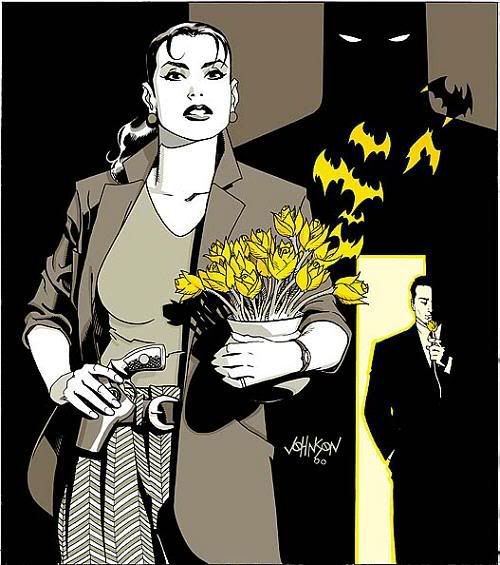
- Renee Montoya, from Gotham Central and Batman and other comics. A lesbian cop - okay, it's a cliche, but she's terrific. At least, she was - I stopped reading 52, where she is currently appearing, partly because I didn't like what they were doing with her.
![[livejournal.com profile]](https://www.dreamwidth.org/img/external/lj-userinfo.gif) dewline tells me that her story is improving again.
dewline tells me that her story is improving again. - Stephanie Brown, who was Robin, and Spoiler, in the Batman saga. Batman turned her away when she disobeyed him (in order to save his life), and then she met an ignominious death, which is a shame, because I loved her as Robin. I also loved Frank Miller's Carrie, in The Dark Knight Returns, who was a similar character. I also loved Jubilee in Marvel comics, who was just similar enough to Steph (and the Robin characters) to make me not add her to my list here. Jubilee played the Robin role as sidekick to Wolverine for a while, and they were great together. Jubilee had the added attraction of not being blonde - she was Asian in appearance. She has, as far as I know, fallen into disuse in the Marvel universe, and I miss her.
- Emma Frost, who is not a nice woman, but she's a fascinating one. A long-standing Marvel mutant, she's another example of great character development. I'm behind in my reading, so I don't know -and don't tell me! - what's currently happening with her. Last read in Astonishing X-Men by Joss Whedon. Her romance with Scott Summers was brilliant. I could write about the background baggage for pages.
The best female characters in novels:
- Philippa Somerville, owlish protagonist in the Lymond books by Dorothy Dunnett. I love her mother, Kate Somerville, even more, but it's Philippa who gets some of the best scenes.
- Lady Katherine Samantha Campion Talbert from The Privilege of the Sword by Ellen Kushneer.
- Joanna Dark, in Perfect Dark: Initial Vector by Greg Rucka. Yes, it's an action story based on a video-game, and Joanna is very like a comic book hero. Not that I would complain about that; it's one of her strengths. I am tempted to cite Rucka's other heroine, Bridgett Logan, from Shooting ant Midnight and others in the Atticus Kodiak series, but she lost points from me when she failed to stand by Atticus, or understand what was happening with him. Rucka invented Renee Montoya, cited above, and did great work with other comic book women like Elektra.
- Elizabeth, The Paper Bag Princess.
- Cordelia Naismith, in the Vorkosigan novels by Lois McMaster Bujold.
This is the hardest category of them all.


![[identity profile]](https://www.dreamwidth.org/img/silk/identity/openid.png)




no subject
Date: 2007-03-11 05:48 pm (UTC)♥
no subject
Date: 2007-03-12 12:58 am (UTC)no subject
Date: 2007-03-11 05:50 pm (UTC)no subject
Date: 2007-03-12 01:00 am (UTC)I thought that after I wrote this I'd be thinking of changes and additions all afternoon, but no, I haven't. Not so far. I might want to add "theatre" to the list, but... I'm not sure.
Rose Tyler didn't look promising at first and then she turned out to be amazing. And now when I look back, I see that potential in her right from the beginning of "Rose".
no subject
Date: 2007-03-12 04:31 am (UTC)Agree about Rose - what an amazing trajectory! But when I rewatched her early episodes, you're right, that potential was right there from the beginning.
no subject
Date: 2007-03-12 11:36 am (UTC)Yes!
Dana Scully in the early seasons of X Files,
I liked Scully but my focus was on Mulder... I don't know if she ever would have made my 'remarkable' list, even in early seasons. What really threw her off my list even in potentiality was the last couple of seasons. Amazing disappointment - I was totally against her romance with Mulder - akin to the treatment of DeLenn in Babylon 5.
Agree about Rose - what an amazing trajectory!
Yes. I can't think of many characters - male or female - in popular media who have had such a "heroe's journey". And so convincingly.
you're right, that potential was right there from the beginning.
Yes. Invisible till afterwards, I think, but always there.
no subject
Date: 2007-03-11 06:15 pm (UTC)I think for myself, on TV, it would have to be Willow from Buffy, just because of the character development. She was actually allowed to grow and change over the years, while still essentially remaining herself. In comics, it's a toughie as although I never really managed to relate to Kitty very well, there are so many other good ones to choose from. I think I have a sneaking liking for Sage, though, and Betsy's always a joy to write. In books, it's got to be Harriet Vane from the Dorothy L Sayers. Oxford's changed a lot since she was here, but there's something so accurate in the way she catches the atmosphere, and Harriet (the first Mary Sue? ;)) is always good company.
I shall now have to go and seek out all these women I don't know! Should keep me in books for a while...
no subject
Date: 2007-03-12 01:13 am (UTC)Glad you thought so!
I only know about half of these names, although it's the second time recently that I've come across the Vorkosigan novels, so I'm thinking I'll have to go seek them out.
I think you should. They are terrific novels; I have my favourites, and would in fact encourage you to start with either Shards of Honour, which is the first chronologically, but not typical of the series - it also happens to be my favourite. You could also start with Cordelia's Honour, which puts the novels that come first chronologically together in one volume, Shards of Honour and Barrayar. These are the books whose protagonist and viewpoint character is Cordelia Naismith. She appears in later books, but never in such a central position again.
If you don't start with either of those, start with The Warrior's Apprentice, which is the first one I read, and it sets up the main themes of the series - the career, life and mind of Miles Vorkosigan.
I think for myself, on TV, it would have to be Willow from Buffy, just because of the character development.
I know she's very popular.
And yay for "The Paper Bag Princess"!
I read it as an adult, and wished I'd read it as a child.
although I never really managed to relate to Kitty very well, there are so many other good ones to choose from
So very true. My attitude to Kitty - and perhaps to all the women in X-Men - waxes and wanes depending what storyline and what writers we are dealing with. Artists too. There are stories which would make me pick Storm, or Rogue, or Pyslocke as a favourite - but it isn't consistent over time. I love Elektra when she's being done 'right', which is to say, according to my tastes and conception of the character. I wanted to talk about some female characters in The Legion of Super-Heroes except that at present I don't think I can stand any of them. And I left out a character who may be my favourite female super-hero of all time - Supergirl. Except that I haven't always followed her comics, because, as usual, the character shown isn't always the version of Supergirl I want to see.
And even further: I was only talking about mainstream comics there. There are female characters I love who are completely outside that genre. Liek Maggie and Hopey in Love and Rockets (early days, anyway) and Rose in Bone and Akiko and - well, the more I think of it the more rich the pickings are.
I don't feel I understand Sage very well. Why do you like her? I don't dislike her, but don't have a feel for her. Good look, though.
In books, it's got to be Harriet Vane from the Dorothy L Sayers.
I almost said her, but it would be slightly dishonest: I haven't read a lot of Dorothy L Sayers novels. Yet. But I've read enough to know I love Harriet Vane. Do I love her for herself, independent of Lord Peter? ...Yes, I think so.
I look forward to hearing what you think of these books and these characters. Happy reading to you.
no subject
Date: 2007-03-11 08:21 pm (UTC)no subject
Date: 2007-03-12 01:19 am (UTC)no subject
Date: 2007-03-11 08:46 pm (UTC)Film/Drama:
Maleficent in Disney's Sleeping Beauty: sheer glamour and style.
Barbara in The Wicked Lady: bad, dangerous, and great fun; runs rings around the 'good' characters.
Countess Geschwitz in Wedekind's Lulu plays: brave, good, selfless – a pity she gets killed off when she's decided to go home and study law to work for women's rights.
Silvia in Pacte des Loups: 18C courtesan and spy, armed with a steel-bladed black lace fan. Superheroines should be more like this!
Hedda Gabler in Ibsen's play of that title: trapped and self-destructing in a mediocre existence in 19C. I wish I could help find a way out for her.
Books:
Sara Crewe in A Little Princess: a childhood favourite. Some would call her a rampant Sue; I found her inspiring for maintaining her dignity and her vivid imagination through several years of adversity.
Cigarette, the French/Algerian vivandière in Ouida's Under Two Flags: I think it's down to her that I first realised I was not exactly heterosexual... She's sexy, playful, brave and good fun. The hero, for whom she sacrifices herself, isn't worth it: I'd have been much amused to pair her with his aristocratic love-interest Lady Venetia.
Carmilla, in Lefanu's Carmilla: the original lesbian vampire.
Eustacia Vye in Hardy's The Return of the Native: another vibrant, bright, lively girl, trapped in a narrow environment.
Audsley King, in M John Harrison's In Viriconium and Viriconium Nights: a consumptive artist, partly inspired by Aubrey Beardsley, Paula Modersohn-Becker and others.
no subject
Date: 2007-03-12 01:24 am (UTC)Good phrase! Personally, I never use the term Mary Sue and avoid it whenever possible. It doesn't mean much, in my opinion, except that someone thinks there is bad writing involved. Often true, but it's also often a cheap shot.
but never struck me that way at the time.
Which I would take as an indication that something was being done right.
Maleficent - yes! She had style and to spare.
Silvia in Pacte des Loups: 18C courtesan and spy, armed with a steel-bladed black lace fan.
Sounds like just my kind of girl!
Hedda Gabler
Oh, yes. I liked her too.
I've already made a note of Harrison. I too loved Sarah Crewe. Cigarette sounds like a character I'd like, too. Thanks for the list. Very intriguing.
no subject
Date: 2007-03-11 10:42 pm (UTC)I love that story! I love how she gave the prince the shove-off and went marching off to be her own hero.
no subject
Date: 2007-03-12 01:33 am (UTC)no subject
Date: 2007-03-12 09:31 am (UTC)Said daughter (known as a lot of things including "the feminist's feminist")says she's only found two male writers that she thinks can do women's voicies and characterisation properly: Anthony Trollope and Stephen King. Trollope to such an extent that when she was in her teens she asked me, "Trollope isn't one of these George Eliot dels, is he? I mean, was he really a man?" It was only when she discovered that Trollope's mother was a novelist that she said she understood how he pulled it off.
She has commented that, without knowing from the inside, she has always felt that women writers are usually better when it comes to male characters, but thinks this may have been due to social expectations in the past; culturally, men were not expected to understand how women's minds work, but women were expected to understand the men in their families. If this is true, it may actually be becoming harder for women to write satisfactory male characters.
As to the choice of protagonists, what I am mostly interested in writing is historical fiction, and there are difficulties that have to be faced up to in using female characters as the available experiences in many societies were so limited, and if anything interesting is to happen it may be necessary to make the protagonist out of the ordinary for her time. This has led to an awful lot of bad novels with anachronistically "feisty" (I hate that word) heroines.
no subject
Date: 2007-03-12 01:03 pm (UTC)And I am of course having all the same decisions about viewpoint, identity and voice. I have no qualms about trying to write with a male voice - I've been doing it in fanfic all these years! - and of course there are simliar problems with regards to roles which relate to gender.
Interesting about Trollope. Some men are spectacularly bad at writing women - Dick Francis comes to mind, but he's otherwise good, so I chuckle at his cardboard women and carry on. Heinlein was terrible too, largely because he was trying too hard. Robert B. Parker is making a commendable effort with his Sunny Randall series - with some problem in tone, but I'm not sure I wouldn't just accept that if I thought it was a female author.
She has commented that, without knowing from the inside, she has always felt that women writers are usually better when it comes to male characters
I've always thought that, but it might be simply that I can't read it as a man would read it.
I hate the word "feisty" too. It's almost as bad as "spunky". It's condescending.
no subject
Date: 2007-03-12 05:09 pm (UTC)It's more the fact it seems to be derived from "farty". Plus it's a hideous Americanism.
no subject
Date: 2007-03-12 07:34 pm (UTC)no subject
Date: 2007-03-12 07:44 pm (UTC)feisty
1896, Amer.Eng. from feist "small dog," from fice, fist Amer.Eng. 1805 "small dog," short for fysting curre "stinking cur," attested from 1529, from M.E. fysten, fisten "break wind" (1440), related to O.E. fisting "stink." The 1811 slang dictionary defines fice as "a small windy escape backwards, more obvious to the nose than ears; frequently by old ladies charged on their lap-dogs." Cf. also Dan. fise "to blow, to fart," and obs. Eng. askefise, lit. "fire-blower, ash-blower," from an unrecorded O.N. source, used in M.E. for a kind of bellows, but orig. "a term of reproach among northern nations for an unwarlike fellow who stayed at home in the chimney corner" [O.E.D.]
So how'd it get its current meaning?
From the online Mirriam-Webster:
feisty
One entry found for feisty.
Main Entry: feisty
Pronunciation: 'fI-stE
Function: adjective
Inflected Form(s): feist·i·er; -est
1 chiefly Southern & Midland a : full of nervous energy : FIDGETY b : TOUCHY, QUARRELSOME c : exuberantly frisky
2 : having or showing a lively aggressiveness : SPUNKY
<b>feisty</b>
1896, Amer.Eng. from feist "small dog," from fice, fist Amer.Eng. 1805 "small dog," short for fysting curre "stinking cur," attested from 1529, from M.E. fysten, fisten "break wind" (1440), related to O.E. fisting "stink." The 1811 slang dictionary defines fice as "a small windy escape backwards, more obvious to the nose than ears; frequently by old ladies charged on their lap-dogs." Cf. also Dan. fise "to blow, to fart," and obs. Eng. askefise, lit. "fire-blower, ash-blower," from an unrecorded O.N. source, used in M.E. for a kind of bellows, but orig. "a term of reproach among northern nations for an unwarlike fellow who stayed at home in the chimney corner" [O.E.D.]
So how'd it get its current meaning?
From the online Mirriam-Webster:
feisty
One entry found for feisty.
Main Entry: feisty
Pronunciation: 'fI-stE
Function: adjective
Inflected Form(s): feist·i·er; -est
1 chiefly Southern & Midland a : full of nervous energy : FIDGETY b : TOUCHY, QUARRELSOME c : exuberantly frisky
2 : having or showing a lively aggressiveness : SPUNKY <the movie's feisty heroine>
- feist·i·ness noun
Precisely what we were taking about. (I like the definition as "quarrelsome".)
Wikipedia says: (http://en.wiktionary.org/wiki/feisty)
feisty - tenacious, energetic, belligerent, spunky
prepared to stand and fight, often despite small stature or lack of strength
and points to 'feist' - (http://en.wiktionary.org/wiki/feist)
Noun
feist (plural: feists; spelling variant: fist, plural: fists)
(US regional) a small snappy belligerent mixed-breed dog
(vulgar) A silent fart
[edit] Derived terms
feisty
Retrieved from "http://en.wiktionary.org/wiki/feist"
But how? and when?
no subject
Date: 2007-03-12 07:45 pm (UTC)I'm doing my best to be accurate, but if the sources aren't helpful when it comes to dates, it's a bit tricky! As with spellings of names, if I can't find anything authoritative I make an executive decision
I agree about it being hard to judge, but it's only rarely that I see a male reviewer complaining that a female writer can't write men, while the other way round is common.
As to getting inside their heads... I'm finding the male character much easier, mostly because the female character is a mathematician, which Iknow well from just outside (my late husband) but not from inside. Fortunately my daughter takes after her father in a lot of ways, though she did complain once about me using her when I wanted to show "Anna in stroppy cow mode".
no subject
Date: 2007-03-12 07:51 pm (UTC)I like that. I almost did 5th-6th century studies at Aberystwyth for my MA; ended up doing 12th century Crusades in London, and was happy with it.
Why will the sequel upset people?
As with spellings of names, if I can't find anything authoritative I make an executive decision
Names! Don't talk to me about names. In the 12th century vernacular, everyone used the same set of named, and then spelled them differently each time they were written down. It's fun to count the variations. I can't help loving them for it.
it's only rarely that I see a male reviewer complaining that a female writer can't write men, while the other way round is common.
Good point.
she did complain once about me using her when I wanted to show "Anna in stroppy cow mode".
LOL - oh, to see ourselves as others see us!
Where's it set geographically?
no subject
Date: 2007-03-12 05:12 pm (UTC)There are too many bad novels, full stop.
no subject
Date: 2007-03-12 06:29 pm (UTC)I'm picky. I want good novels and good history. Together. Not too much too ask - ?
no subject
Date: 2007-03-12 06:40 pm (UTC)I suspect it possibly is. If the history is that good, why turn it into fiction? If I'm honest, I tend to hate novelists playing games with people I love: I don't need them to interpose their imaginations between me and their subjects.
no subject
Date: 2007-03-12 06:50 pm (UTC)I suppose they do. When I think of it, there's a lot of bad science in the SF out there, too. And then there are the exceptions.
I want to be an exception.
no subject
Date: 2007-03-12 06:58 pm (UTC)Many science fiction writers are good at both writing and science. Why then don't the same standards apply to historical fiction?
I suppose they do. When I think of it, there's a lot of bad science in the SF out there, too.
Yup. Frankly, the vast majority of fiction isn't worth the death of a tree. Unfortunately, the publishing industry, and readers who have no critical faculties whatsoever, keep it going.
no subject
Date: 2007-03-12 07:00 pm (UTC)no subject
Date: 2007-03-12 07:37 pm (UTC)1. Actual events. There has to be a very, very good reason to tamper with them.
2. Actual people. What you do with them is also very limited.
3. The whole ambience, background, assumptions, clothes, houses, food, travel - all that sort of thing. If people don't get that right, I don't see why they are writing historical fiction (as opposed to, say, fantasy) in the first place.
If the story is just the actual facts and actual individuals, yes, I agree with you. But if a story is being told in a particular setting, that's another matter.
no subject
Date: 2007-03-12 07:54 pm (UTC)I can think of two writers who make their works fantasy rather than history, but who manage to understand the history well anyway - I'm thinking of Guy Gavriel Kay and Megan Whalen Turner when I say this.
no subject
Date: 2007-03-12 08:24 pm (UTC)Sadly, it doesn't stop them.
2. Actual people. What you do with them is also very limited.
That doesn't stop them, either... I have seen truly horrific things done to people I love (including twisted, violent porn scenarios), and justified in the name of "free interpretation". My view: if you haven't got evidence for it, don't say it.
3. The whole ambience, background, assumptions, clothes, houses, food, travel - all that sort of thing. If people don't get that right, I don't see why they are writing historical fiction (as opposed to, say, fantasy) in the first place.
I wish some would write original fiction/fantasy instead of messing with reality...
If the story is just the actual facts and actual individuals, yes, I agree with you. But if a story is being told in a particular setting, that's another matter.
Indeed. I have less of a problem with entirely fictional stories set in various times – although, again, writers need to think about the mind-set and culture and not use modern characters in fancy dress.